
AZAR | Luxury Residential Interior Design in Potts Point
We create spatial design strategies that turn architectural challenges into high-value residential assets. For this project in Potts Point, Sydney, we developed a bespoke interior design solution that enhanced the property’s market value through refined spatial planning, materiality, and detail.
Project Details
-
Location: Sydney, Australia
-
Total area: 36 sq. m.
-
Status: In progress


Case Study: 36m² Studio Transformation in Potts Point
How do you turn a 36 m² studio with no view into an apartment that feels more valuable?
In Potts Point, on the edge of Kings Cross, we worked with a compact 36 m² studio. The property had a strong location, clear rental potential and a solid investment logic, but it also had one obvious limitation: the windows did not look out onto the city, the harbour or greenery. They faced the brick wall of the neighbouring building.
We did not try to compete with the view. Instead, we shifted the value of the apartment inward. The task was not simply to create a beautiful interior. The goal was to change how the property was perceived: to transform a small studio into a true one-bedroom apartment with a flexible layout, a private sleeping zone, sufficient storage and the atmosphere of a calm, refined European interior.
Spatial Strategy & Layout Optimization
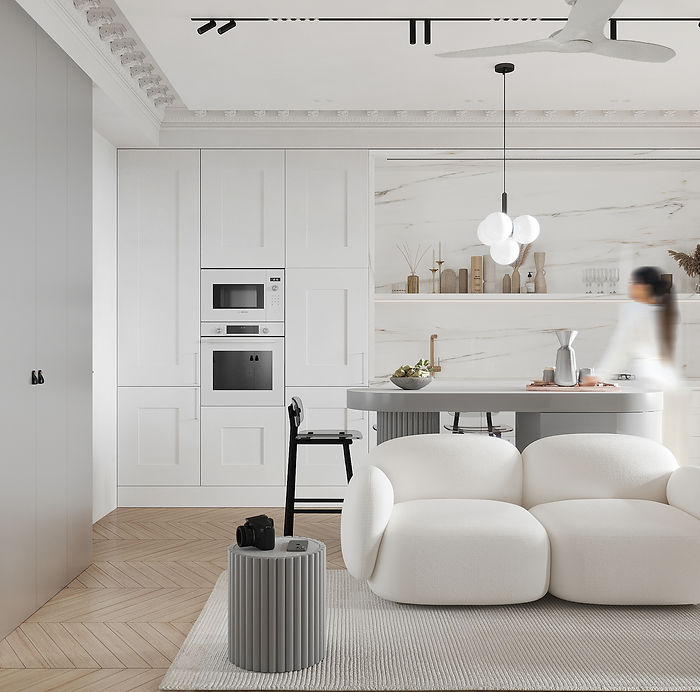
The rounded island became the centre of the plan. It brought together the kitchen, dining area, storage and circulation into one architectural element. Its soft geometry made the space feel less narrow and rigid: movement became more fluid, and the interior felt more complete.
The bedroom was separated with sliding glass doors. During the day, they can be opened so the apartment works as one bright, continuous space. In the evening, they can be closed to create a private sleeping area. This solution preserved light, air and visual depth while giving the buyer something the market values more than a studio: a separate bedroom.
Premium Materials & High-Value Aesthetics
We reduced visual noise through integrated storage, avoided heavy overhead kitchen cabinets, and used a light palette, reflective surfaces and warm chevron timber flooring. The aluminium finish of the wardrobe reflects natural light and visually softens the volume, while the stone texture of the kitchen adds density and a sense of quality.
In a suburb where one-bedroom apartments form a distinct price and rental segment, these decisions work commercially as well as aesthetically. For the buyer, this is no longer a compromised studio with a poor outlook. It becomes a compact urban apartment with a considered layout, privacy and a premium feel.
Here, 36 m² stops being a limitation. With a precise spatial strategy, even a small property with difficult starting conditions can become an asset with higher perceived value — for resale, rental return and long-term capital retention.